A Charlie Brown Christmas Redux ... and redux and redux
By Derrick Bang
It was so simple, once upon a time.
If you wanted the soundtrack, you bought the album ... as in LP, as in long-playing record, for those too young
to recognize the term.
No muss, no fuss. LPs served us well for decades. And, with the exception of Broadway revivals,
or classical music performed and interpreted by different orchestral ensembles, we'd rarely find more than one album
with the same music.
So it was, with the Vince Guaraldi Trio's score for the trend-setting CBS-TV special,
A Charlie Brown Christmas. Fantasy Records released an LP shortly after the show debuted on December 9, 1965;
it made an excellent companion piece to Guaraldi's other Fantasy album of Peanuts music, the soundtrack for
the never-aired TV special, A Boy Named Charlie Brown.
Although long forgotten by the general public, Peanuts fans and soundtrack collectors know that Guaraldi's music
also could be found on another album -- with the same title -- produced in the wake of that first TV special's 1965
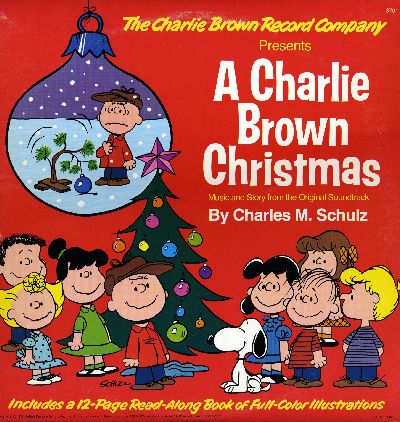
debut: the Charlie Brown Record Company LP that condensed A Charlie Brown Christmas and turned it into the
equivalent of a radio experience, complete with 12-page storybook. With a running time of just under 20 minutes,
this LP retained the essential dialogue elements while -- sadly -- eliminating most of Guaraldi's musical interludes
(which is logical, since young listeners wouldn't have had any reference by which to imagine the action taking
place behind uninterrupted music). Indeed, purchasers of the LP wouldn't even know of Guaraldi's involvement;
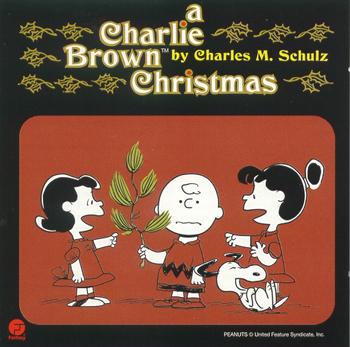
the LP cover credits Charles M. Schulz but says nothing about the music. (Fortunately, the record label -- on the disc itself -- does
mention Guaraldi.)
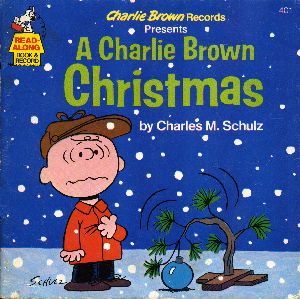
The Charlie Brown Record Company produced a second, physically smaller version (7 inches) of this radio-esque
adaptation, probably designed for children who had those little hatbox-style phonographs that were incapable
of playing full-size LPs. A book and tape version also was released. The
packaging was identical to the blue art on the right above, with two slight
distinctions: The item number was 401B, rather than 401 (upper right corner), and
the text in Snoopy's doghouse (upper left corner) read "book and tape," rather
than "book and record."
Guaraldi's full musical score, though, was available only on the Fantasy LP.
And so it was, for nearly two decades. Although avid fans knew the TV special had bits of music not included
on the LP, we couldn't do anything about it ... except watch the show each December, and/or record the audio
with a cassette tape deck.
To a great degree, the album's content was dictated by its form. The two sides of a long-playing record
could hold only so much music -- generally about 40 minutes -- and thus we proud owners of
the Charlie Brown Christmas LP grew quite familiar with the five tracks (songs) on the first side,
and the six on the second side.
Then, in March 1983, compact disc technology arrived ... and suddenly it was a whole new ballgame.
Thanks in great part to this new medium's size, ease of use and greater storage capacity -- granting
performers more than 70 minutes of music per disc -- the transition from LP to CD took place pretty smoothly.
Oh, sure; some purists complained (and rightly so) that "CD sound" was a bit too bright and lacked the warmth
of an LP, but that was more of an issue in the early days. (CD technology has improved a lot since then.)
Getting us to buy new CDs was easy; getting us to upgrade our existing LPs to CDs was a bit more of a struggle,
at least for the first few years.
So, in order to sweeten the deal -- and whenever they could -- music labels offered bonus tracks on older LPs
that were revived on CD. Fantasy Records' first alternate state of the soundtrack
to A Charlie Brown Christmas arrived when the album debuted on CD in 1986. This initial CD release reproduced the
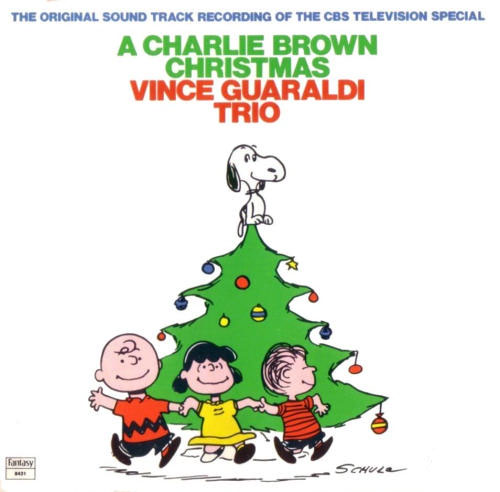
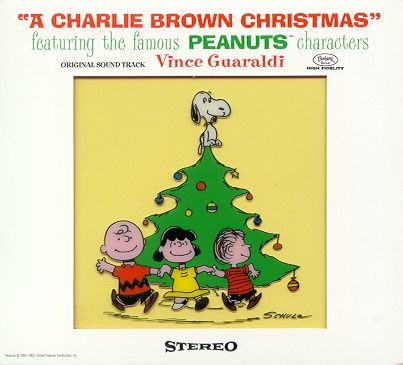
LP precisely -- in other words, only 11 tracks -- along with the original artwork, as shown at the top of this page.
The liner notes also were reproduced precisely, which is to say that no sidemen were mentioned.
The 1986 issue is all but forgotten today (even by Fantasy), because it was
"upgraded" two years later. The 1988 release found the existing 11 tracks augmented
by a 12th "bonus track": a longer, alternate take of "What Child Is This," rather coyly titled "Greensleeves," perhaps in the
hope of tricking unworldly purchasers into believing it was an entirely new song. The 1988 disk also sounded a bit
better, both in terms of mastering and volume; the 1986 disk, rather oddly, was rather quiet (which may
also have prompted the improved version two years later). This 1988 disc also retained the original cover art, and
credited sideman Monty Budwig (bass) and Colin Bailey (drums).
Since then, things have gotten ... well, rather crazy.
Guaraldi's original album now exists in many, many different states, having been re-released and re-re-released,
covered by other artists, and even branded by the likes of Starbucks and Hallmark.
But let me not get ahead of myself.
In the interests of knowing what were buying, what follows discusses the various differences -- if any -- between
the many new versions of A Charlie Brown Christmas that have arrived since CDs debuted.
So, returning to Fantasy's first CD release, in the 1980s...
The next change, many years later, came in under the radar and was prompted solely by Fantasy's attempt to correct
its liner notes. Fantasy was long notorious for its poor record-keeping and even poorer acknowledgments,
much to the dismay of jazz fans, who always want to know who plays what instrument on which track.
As mentioned above, Fantasy's original LP failed to mention Guaraldi's sidemen, although the information did surface on Fantasy's
Greatest Hits compilation of the jazz pianist's work, which of course included some of the Peanuts tracks.
According to that LP, Guaraldi was accompanied by Fred Marshall (bass) and Jerry Granelli (drums).
But, as mentioned above, that 1988 CD issue of A Charlie Brown Christmas cited Monty Budwig (bass) and Colin Bailey
(drums) as the musicians who complemented Guaraldi's piano.
Hmmm.
Writer Robert Wilonsky investigated this curious discrepancy in
an article
published in the weekly Dallas
Observer dated December 17-23, 1998. The article is a bit hyperbolic, and Marshall wasn't entirely happy with
the sensationalist tone added to what was, at worst, a minor controversy regarding proper credit. Fantasy
tried to set the record straight with a slightly revised A Charlie Brown Christmas in August 1999.
The first 11 tracks -- which is to say, all the cuts from the original LP -- were credited to Marshall
and Granelli. The bonus version of "Greensleeves," added back in 1988, was assigned to Budwig and Bailey,
the two members of Guaraldi's original trio.
Why the two sets of sidemen?
Very simple: Guaraldi worked with one pair while laying down the tracks for the actual TV show, but teamed
with the other pair when recording the cuts for the Fantasy Records release. Fantasy, with its tendency toward
sloppiness, drew tracks from both sessions ... and didn't bother telling anybody (at first, anyway). Trouble is,
evidence suggests that the "split" isn't nearly as cut and dried as the revised credits suggest, a situation
discussed at much greater length
here.
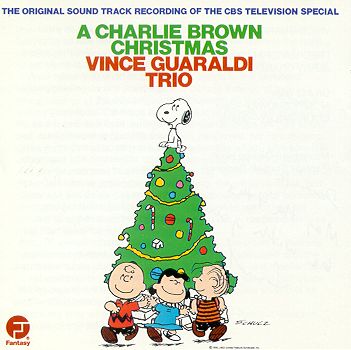
At some point prior to this shift in credits, Fantasy released a fresh cover design for this disc, which can
be seen above left; note the poses of Charlie Brown, Lucy, Linus and Snoopy. It would have been nice if Fantasy had waited on
the revised credits, before changing the artwork ... but it didn't work out that way.
(A 1992 Musical Heritage Society CD release employed the second-gen cover art, but in all other respect duplicated
Fantasy's 1988 release: which is to say, only Budwig and Bailey were cited as sidemen. Ergo, the cover art changed at
some point between 1988 and 1992.)
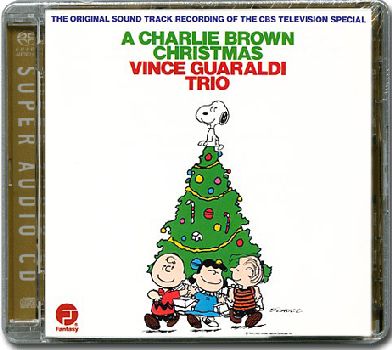
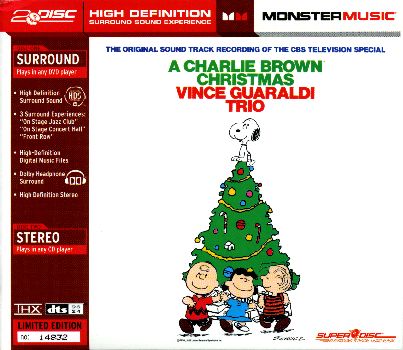
A few years later, two additional versions of the 12-track CD were issued -- the original 11 tracks,
plus the bonus track version of "Greensleeves" -- as Fantasy's way of testing
the market offered by so-called superior listening formats: Super Audio CD (SACD), on August 26, 2003; and
Monster Music, in November 2005. Both required different equipment; SACD CDs won't even play on standard CD
players, and Monster Music discs are designed for DVD players. To be precise, Monster Music wasn't really a
new format; the music was remixed into Dolby Digital 5.1 and DTS audio tracks -- as used for regular DVD
soundtracks -- and stuck onto a DVD without a video track. (Text displaying the name of the track appeared
on the screen instead.) Note, as well, that the Monster Music release came with two discs: the
aforementioned DVD, and a CD that essentially was the same as the original album.
Although theoretically reconfigured to take advantage of the supposed enhancements offered by these
two formats, the same 12 tracks were used ... but, rather perversely, the Monster Music DVD presented
them in a different sequence (!). On the other hand, this Monster Music DVD version became a must-have item
for some fans, because it quietly became the first iteration to employ the notorious "Mark 1" versions of several
tracks that made a much more controversial splash on Fantasy's 2006 re-mixed CD (see below). Since it remained
impossible to determine a "Mark 1" version of that 2006 Fantasy CD before purchasing and listening to a copy -- a
frustrating state of affairs discussed at length
in this entry
in my Guaraldi blog -- one did, at least, have
the satisfaction of knowing that the Monster Music DVD was that way. (The Monster CD, on the other
hand, used the standard track sequence, and the usual "classic" recordings.) Note, as well, that while the cuts on the
Monster DVD were re-mastered and re-mixed, it was not the superior re-mixing done for Fantasy's 2006 "Mark 1" version.
All that said, simply in terms of the audio experience, I rather doubt most casual listeners could tell the
difference with either of these formats. Absent a $2,000 entertainment system, I defy anybody to distinguish a standard CD from an SACD.
In fairness, though, I'll let good buddy and fellow audio enthusiast Scott weigh in with his thoughts:
Super Audio CD is capable of reproducing a wider range of sounds than regular CDs.
Due to the (relatively) limited technology and storage space available when CDs were created in the 1980s,
some modest compromises were made: Good as they are, CDs do not capture the widest possible range of sounds.
Super Audio CDs use more modern and advanced music digitization and storage techniques -- in computer terms,
more bits are used to store the music -- and in theory can produce better-sounding music.
In practice, though, you'd need both very good equipment and very good ears to tell the difference between
a regular CD and a Super Audio CD.
The stated attraction of the Monster Music release was the presentation of music in surround sound,
to provide a more immersive listening experience. As with a good surround soundtrack on a movie DVD, the
music from A Charlie Brown Christmas was remixed so that it appeared to come from all around you.
In fact, the Monster Music disc actually is a DVD, which plays in regular DVD players. (The package also
included a CD that was essentially identical to the original Fantasy release.)
The DVD presents the music in no fewer than four different ways: three surround-sound versions, and one
"high definition stereo" version. Each surround-sound track is available in both Dolby Digital 5.1 and DTS, the two
main DVD surround sound formats. The three different surround tracks are intended to emulate three different
performance spaces: "On Stage at a Jazz Club," "On Stage at a Concert Hall" and "Front Row at a Theater."
They're supposed to sound like you're in one of these settings, listening to Vince and his trio perform
the music. But while modern movie soundtracks are designed and recorded with a surround experience in mind,
the music for A Charlie Brown Christmas, recorded in 1965, was not.
Monster Music went back to the original source tapes for the
special's music, but it was originally recorded as three different
tracks (each track recording only certain instruments), and one generally
needs at least as many tracks as speakers to make an effective
surround sound mix. To make do with anything less requires some
digital trickery to spread the music from two speakers -- as used in a
normal stereo set-up -- to the five speakers (three in front, two in the rear)
used in surround sound set-ups.
When listening to the surround tracks on a surround sound system,
most of the music comes out of the front speakers, but reverb has
been added to make it sound like the music is echoing out of the rear
speakers. Inexplicably, the drums play on the rear speakers. If
you were watching the performers on a stage, why would the drums be
behind you? But I guess to make the soundtrack "enveloping," the
producers felt they had to put something on the rear speakers.
The results aren't unpleasant, and the enveloping works to a degree, but I'm not convinced that the
results are better than listening to the new, remastered version of the Fantasy album on a decent two-speaker
stereo system. Also, the digital trickery required to make a surround version of this music -- since it never
was intended to be played on a surround sound system -- may offend some purists.
These two formats have been mentioned solely for the sake of completeness, and also because it's significant
that Fantasy selected Guaraldi's album for them; only a small percentage of the conventional CD library
ever was re-released on either SACD or Monster Music, and neither format penetrated the
mainstream market. (You can count the Monster Music releases on the fingers of both hands!)
That said, SACD has remained reasonably well-established, and new discs continue to be released.
SACD is regarded as an official format -- much
like CD and DVD -- and SACD discs are (and have been) made by multiple companies.
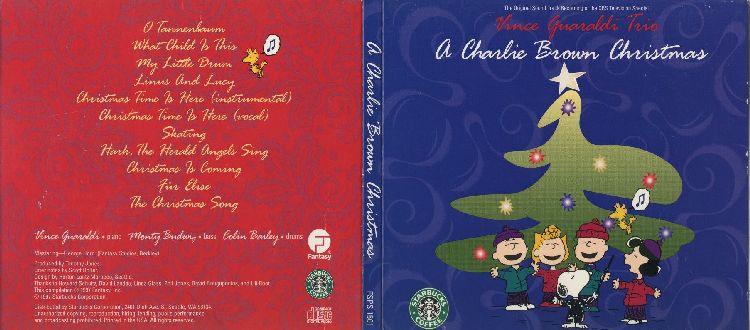
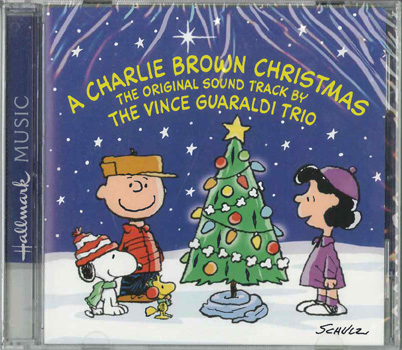
The acknowledged popularity of Guaraldi's A Charlie Brown Christmas score also led to the album
being branded by both Starbucks (December 1997) and Hallmark (December 2000). Oddly, the Starbucks version
featured only the original 11 tracks found on the LP; the bonus version of "Greensleeves" was absent.
Although the price was a bit more attractive than Fantasy's mainstream version of the disc,
the Starbucks variant is desirable only because it, too, uses fresh artwork ... otherwise, it's entirely superfluous.
Of all the many different versions of this album, released over the years, this
Hallmark version is the only one to warrant a big, fat raspberry of disapproval ... because
it's the only version that doesn't include the entire album. This Hallmark
disc has only 10 tracks; although it does include the bonus version of "Greensleeves,"
it inexplicably omits Schroeder's piano solo version of "Fur Elise" and -- much,
much worse -- the kids' vocal version of "Hark, the Herald Angels Sing," which
brings the original show to such a joyous conclusion. Nothing but coal in your
stocking, Hallmark!
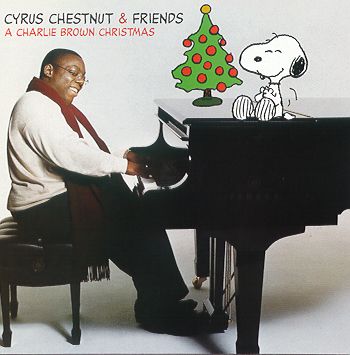
The same year that Hallmark so poorly branded Guaraldi's music, Atlantic Records released a rather unusual concept
album: jazz pianist Cyrus Chestnut's homage to Guaraldi's original score, also -- and rather confusingly -- titled
A Charlie Brown Christmas (Atlantic 83366-2). Aside from three instrumental originals by Chestnut,
he and various guests re-interpreted Guaraldi's 1965 album. While it's not at all unusual for jazz artists
to cover each other's work -- that's the very nature of jazz -- I can't think of any earlier cases
where one artist did a deliberate, track-by-track re-imagining of a second artist's entire album ... from
the signature Peanuts themes ("Linus and Lucy" and "Christmas Is Coming") to the holiday standards
("The Christmas Song," "What Child Is This" and so forth) that Guaraldi and his trio gave such a distinctive
polish back in 1965.
(Booker T and the MGs came close with their 1970 album, McLemore Avenue, an homage to The Beatles' Abbey Road,
which covers 13 of the 14 songs in that classic 1969 release, arranged as four suites. But it isn't a complete
re-do. Another television soundtrack provides a much better example; all sorts of
other jazz combos covered one or both of Henry Mancini's albums of Peter Gunn music, both back
in the early 1960s and much more recently.)
The results on Chestnut's album are intriguing. Chestnut's approach to the piano is quite spiritual; his interpretations
of "Hark the Herald Angels Sing" and "My Little Drum" (a riff on "Little Drummer Boy") are slow, somber
and absolutely gorgeous. He's equally adept at the up-tempo stuff; his covers of "Linus and Lucy" and
"Christmas Is Coming" are marvelous. Vanessa Williams and the Boys Choir of Harlem also contribute a lovely
reading of "Christmas Time Is Here," with further instrumental backing from tenor saxman Michael Brecker.
But some of the stylistic choices are puzzling. I'm no fan of jazz harmonica, and it's absolutely not
the instrument of choice for "Skating"; a harmonica simply does not say ice skating to me.
Perhaps worse, the otherwise tasty vibes used in "What Child Is This" are obscured by the Manhattan Transfer's
gawpy background la-la-la punctuations, which sound more like something hijacked from a Lawrence Welk
disc. What a waste of that talented vocal quartet ... surely they could have been put to better use!
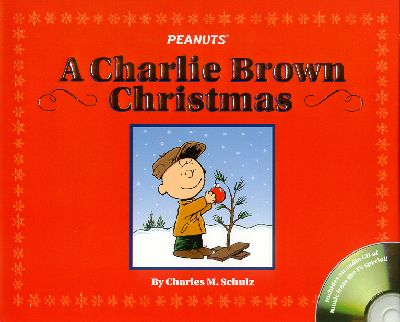
In 2002, Little Simon -- an imprint of the Simon & Schuster children's publication division -- released a
new hardcover storybook adaptation of A Charlie Brown Christmas. The text is adapted by Justine and Ron Fontes
from the TV special, with new artwork by Creative Associate's Paige Braddock (also known for her own comic strip and
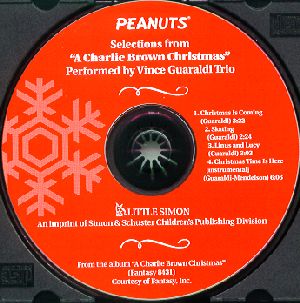
comic book series, Jane's World). The book comes with a 15-minute audio CD that includes four tracks from
Guaraldi's original Fantasy release of A Charlie Brown Christmas: "Christmas Time Is Here," "Skating,"
"Linus and Lucy" and "Christmas Is Coming" ... although, perhaps echoing Fantasy's sometimes sloppy liner notes,
the order in which the tracks play on the CD doesn't match what's printed on the CD!
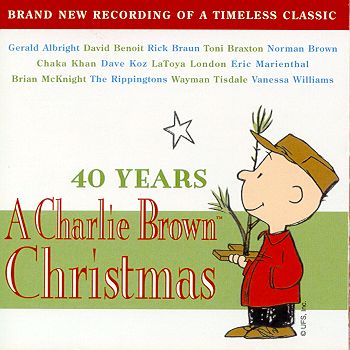
In 2005, history repeated itself when jazz pianist and current Peanuts music
torch-bearer David Benoit and a similar assortment of friends got together for yet another re-interpretation
of Guaraldi's 1965 album. The occasion was the 40-year anniversary of that original jazz LP, and thus
the title, appropriately enough, is 40 Years: A Charlie Brown Christmas (Peak Records PKD-8534-2).
It should be noted that the version of this album sold at Target stores contained two additional tracks
not present if purchased anywhere else -- "The Charlie Brown Theme,"
covered by Wayman Tisdale, and "Hark, the Herald Angels Sing," by LaToya London --
a glaring example of this obnoxious (and, sadly,
increasingly common) marketing practice.
Benoit's album once again covered all the Guaraldi themes and traditional Christmas songs used
in A Charlie Brown Christmas, but the results are mixed, to say the least ... and less satisfying
than Chestnut's album. Jazz purists will lament Benoit's frequent use of strings and vocal wah-wah accents,
and the percussion is too heavy at times, particularly on "O Tannenbaum," where the disco-style beat
overwhelms Gerald Albright's lush sax work.
But many of the cuts are quite nice, starting with Benoit's punchy, swinging cover of "Christmas Is Coming,"
which gets the album off to a great start. Smooth jazz stalwart Dave Koz delivers an equally lively reading
of "Linus and Lucy," trumpet player Rick Braun supplies a solid rendition of "My Little Drum," and Vanessa
Williams brings heart-breaking poignance to the one new song, Benoit's "Just Like Me," which will be adored
by anybody who makes watching A Charlie Brown Christmas an essential part of the season
Hello, little tree,
Kinda looks like me.
Standing all alone,
Like its been disowned.
On the other hand, Toni Braxton destroys "It's the Most Wonderful Time of the Year" -- a song not
even in A Charlie Brown Christmas -- with a breathy, microphone-swallowing delivery that sounds
as if each word is bursting between her lips during the height of sexual passion. And as bad as Braxton's
delivery is, Chaka Khan is even worse on "The Christmas Song": outrageously overwrought, her harsh,
unappealing voice building to a (literally) shrieking climax. Somebody should have muzzled her.
As for The Rippingtons' gawdawful cover of "Red Baron" -- which turns Guaraldi's lively keyboard
instrumental into a soggy, half-baked disaster on guitar -- the less said, the better.
Tribute albums always run the risk of tainting pleasant memories of the original material, and it's sad,
but true: The contributions by Braxton, Khan and The Rippingtons are so dreadful that they overshadow
the rest. That makes 40 Years an uneven novelty item, much like Chestnut's equally puzzling cover
of the same material. Neither posed any threat to the strong sales posted every year by Guaraldi's original recording.
And, speaking of which...
Great things happened in 2006, when Fantasy released its own remastered and remixed version of Guaraldi's original album.
By this point, CDs had become much more firmly established since their debut back in 1983, and record companies lost
most of the sales momentum that resulted from the first-round transitions from LP to CD. As a result, labels
looking to make new money from old material began milking a rather clever scheme: remastering and/or remixing
a CD. Spend a little time with a tweak of one sort or another, and plenty of fans could be suckered ... ah,
persuaded ... into purchasing a second (third?) copy of an album that they probably already
re-purchased when upgrading from LP to CD.
Many remastered albums aren't sufficiently improved to justify the additional out-of-pocket expense,
but Fantasy's 2006 re-release of A Charlie Brown Christmas (FCD-30066-2) is worth every penny, because it's not
just a remaster, but a magnificent remastering job, and kudos go to Cheryl Pawelski (producer), Stephen Hart (remixing)
and George Horn (remastering).
Before continuing, a few paragraphs regarding the distinction between remastering and remixing (courtesy, once again, of Scott):
Typically, when music is recorded for an album, each instrument -- or group of instruments -- is initially
recorded to a separate tape. Then a mixing engineer combines those separated recordings onto a single tape,
balancing the volume level and adjusting the stereo placement of each instrument to create a pleasing listening
experience. That final mixed tape is the "album master."
When an album is remastered, an engineer starts with the original album master tape -- with all the
instruments already combined -- and tweaks or cleans up the sound based on the original mixing, trying to
improve the sound while retaining the original balancing and placement of the instruments.
By contrast, when an album is remixed, the engineer instead goes back to the original separated tapes
for each instrument, and creates a new combination of them, possibly with different volume choices for
each instrument, or different stereo placement. New technology and techniques developed since the time
of the original mixing means that a remix can sound cleaner, fuller, and "better" than the original,
revealing subtleties hidden by the original mix. But a new mix can also be controversial, because the
result will sound different from the original mix that fans have been listening to for decades.
And many people -- not unreasonably -- want to enjoy the album as they remember it sounding.
Bravo to Fantasy, and all involved with this CD. Even the packaging and enclosed booklet are A-plus efforts.
I'd be embarrassed to admit how many times I've purchased this album over the years, in one format
or another; I mention that only by way of explaining that I know these tracks inside out and sideways.
And my admiration comes from the fact that, despite the jargon, this isn't just a remixed version of the album ...
several of the tracks are completely different takes, which for a jazz purist is absolute gold.
I'd have to call this a different album entirely.
You can tell right away, because the opening cover of "O Tannenbaum begins" with a quick piano filigree
and cymbal brush that aren't present on the original album. (It's not an alternate take; we're simply hearing
more of Guaraldi's original recording ... see below.) Similarly, this new version of the ubiquitous
Peanuts theme, "Linus and Lucy," boasts an entirely different second improvisational bridge, and Guaraldi's
other original composition -- "Christmas Is Coming" -- is, as well, an alternate take.
This new version of "Linus and Lucy" also solves one of the great mysteries of Peanuts music: the
source of the lively instrumental interlude that is heard while Snoopy dances about on Schroeder's piano,
before slinking away in embarrassment. We now know that this snippet of music is the aforementioned second
improvisational bridge in this previously unheard version of "Linus and Lucy."
(Speaking of obscure bits of music, I probably should answer another frequently asked question: The
music playing behind Snoopy, as he decorates his doghouse, is a portion of a composition titled "Air Music" when
Guaraldi originally wrote it; the piece can be found, titled "Surfin' Snoopy," on the Fantasy CD Charlie
Brown's Holiday Hits.)
The listening experience of Fantasy's remixed 2006 CD is sharper and brighter throughout, which allows us to hear many more of
the subtler jazz riffs that have made the album a seasonal classic since its 1965 release.
Want specifics? Here you go (notes from a Fantasy staffer, posted to an audio blog, when this disc was released):
Track 1: "O Tannenbaum" -- the original LP version cut off the introduction to the song,
which has been reinstated on this new CD;
Track 5: "Christmas Time Is Here" (instrumental) -- the original LP version fades out at the end
of the song, almost losing the last chord, which can be heard quite clearly on this new CD;
Track 7: "Skating" -- the original LP version fades during the bass solo at the very end,
whereas this remastered CD allows the song to run to its conclusion, which adds about 10 seconds to the track.
These freshened versions are supplemented by four bonus tracks, which grant fans yet more alternate takes of "The Christmas Song," "Greensleeves," "Christmas Is Coming" and "Christmas Time Is Here."
And, as a bit of additional information for hard-core audiophiles:
There has been great speculation and conjecture over whether or not
any noise reduction was employed to generate the new CD. The new CD is remixed
from the original three-track, so the fact that you're not hearing that old
familiar hiss is NOT due to the use of noise reduction, it is rather that the
new mix is much quieter than the two-track stereo master. The only place a
touch of noise reduction was utilized was on Track 10, "Fur Elise," as there is
no three-track for that master; it was originally recorded direct to
two-track.
Unfortunately, the folks at Fantasy -- apparently in response to unhappy patrons who wanted the tracks
to sound just like they did on the 1965 LP -- very quickly decided to "correct" the "mistakes" that were made
on "Linus and Lucy" and "Christmas Is Coming." Just as Star Wars fans were
furious when George Lucas tinkered with the original three films, adding more footage
here and there, the Guaraldi fans who grew up listening to the music from A
Charlie Brown Christmas want it to remain the way they first heard it
in 1965, thank you very much!
Again, from the Fantasy post, shortly after release of this re-mastered disc:
Some of you may have noticed that the new remixed, remastered version of A Charlie Brown
Christmas had two mishaps ... these are as follows:
Track 4: "Linus And Lucy" -- the original LP version was an edit of two different takes, whereas
in the remix for the new CD we ran one of the takes in its entirety. New pressings of the CD will
revert back to the original stereo mix.
Track 9: "Christmas Is Coming" -- the original LP version and the version on the new CD are entirely
different takes. This is an unintentional mistake (those keeping close score will note that both
versions are identical in length, thus confusion ensued during the final master assembly). Our sincere apologies.
It would seem, however, that the Fantasy staffers still weren't being entirely candid. The situation regarding
"Linus and Lucy" was studied at meticulous length in the Steve Hoffman music forums, with the significant details
presented here.
All this notwithstanding, Fantasy made clear its intention to return these two tracks to their original states, in subsequent pressings;
dissatisfied customers were encouraged to send in their "defective" Mark 1 discs to obtain a corrected Mark 2 replacement
(only through March 1, 2007, so don't get your hopes up at this late date).
But -- and here's the irony -- Fantasy didn't make a mistake! The fact that the second bridge
in "Linus and Lucy" matches the onscreen music proves that this is the "TV accurate"
take. To put it the other way, the original LP -- and all the CD releases up to this point -- used a different
take, likely from a different studio session. In a way, then, Fantasy finally got it right ... but now went back to having it wrong.
(Mind you, all of this is totally splitting hairs.)
All that said, this remastered and remixed Charlie Brown Christmas probably isn't a necessary purchase
for casual listeners, who may not notice the difference between this and previous versions, and may
not care that much about the four bonus tracks. But Peanuts fans and jazz buffs who live for the differences
of alternate takes -- where the instrumental riffs really are unique, from one take to the next -- will want
this album on their must-have lists ... particularly since the Mark 1 remastered CD
became an endangered species. According to a Fantasy press release dated December 20, 2006, the masters
were changed, and all discs produced from that point forward returned "Linus and Lucy" and "Christmas Is Coming"
to their original versions.
And what of the original album and its vintage 1965 contents?
You would think, logically, that the original pressing would be retired,
in the wake of this re-mastered version. You'd be wrong. Just as Classic Coke was
revived -- and became the majority choice -- after the "New Coke" disaster,
Fantasy/Concord chose to retain the "vintage" 12-track CD, with the extended
version of "Greensleeves" as its sole bonus track (and the corrected liner notes
that properly divided credit between Marshall/Granelli and Budwig/Bailey). Clearly,
this was a smart marketing move, because the original, despite its un-remixed
simplicity and audio imperfections, continues to be a steady seller. Indeed, many
listeners (as noted above) obviously prefer it that way.
And, as we'll see, this original CD would become Fantasy's preferred choice
in other future collections, as well.
Finally, before we fully depart this exhaustive chapter, Fantasy and Concord
pulled one more odd maneuver in 2006. Perhaps to better distinguish the 12-track
original from the newly released, 16-track remixed and re-mastered version, the music company slapped new
cover art on the former, as shown at left. Although Vince Guaraldi's name retains
its placement on the back and side panels, you'll note that he's conspicuously
absent on the cover ... which instead suggests that Charles M. Schulz was solely
responsible for the CD's contents!
Needless to say, wiser heads quickly prevailed; the original cover art was
restored, and this oddity became little more than a completist's treasure.
Flash-forward to the present day, at which point -- In the Mark 2 edition of the 2006 disc --
"Linus and Lucy" and "Christmas Are Coming" were returned to their original takes, versions,
and back to the original mixes. That said, all the other tracks on the Mark 2 disc remained the new, remixed versions.
On the other hand, all post-2006 discs went back to the original mixes for all tracks.
(Confused, yet?)
And, as expected, it's almost impossible to determine whether you have the first or
second edition until you take it home and play it. Note that word almost. This topic has been covered even more exhaustively in an entry in my Vince Guaraldi blog. The updated news isn't all bad, but it's also not as helpful as we'd all prefer.
So be advised: While new CDs almost certainly will be the second edition, you've no guarantee of that when purchasing
used or remaindered discs.
December 2006 brought another version of the album, as well, although this one was targeted specifically toward audiophile purists.
Analogue Productions, an outfit known for high-end restoration work, produced a re-mastered 45RPM vinyl
version from the original best-possible-case master tapes, with the work done by Steve Hoffman and Kevin Gray. The finished
result, limited to 1,000 copies, best can be described as a high-end vinyl pressing -- an old-fashioned record album, in other words -- but
not technically an LP, since it plays at 45RPM, not 33-1/3. That means the original single platter has been
released on a pair of 12-inch 45RPM platters, because of course all the original music won't fit on a single
platter when played at that speed. This release was well regarded by audiophiles, because 45RPM 12-inch records generally have better sound that 33RPM LPs.
The first disc includes "O Tannenbaum,"
"What Child Is This," "My Little Drum," "Linus and Lucy" and "Christmas Time Is Here" (instrumental). The second disc
has "Christmas Time Is Here" (vocal), "Skating," "Hark, the Herald Angels Sing," "Christmas Is Coming," "Fur Elise"
and "The Christmas Song."
Obviously, this is a specialty item, long out of print at this point; you won't find it in an average music store,
and it rarely pops up at Amazon. Copies originally were for sale here, but now
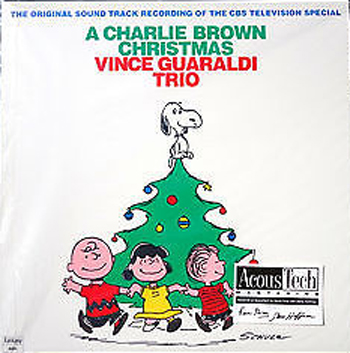
you'll only find testemonials about the pressing's finer points. After-market copies have been spotted at up to $500; if you're thinking of taking that plunge, look for a still-sealed copy that includes the "AcousTech" sticker on the wrapping, as shown at left. For those who want the ultimate listening experience, this
probably is the version to get.
Perhaps hoping to ease the frustration, in 2014 Analogue re-issued the release as a single-disc 33-1/3 LP.
It, too, has become hard to find.
But that's still not all. Late 2006 also brought us another branded version of Guaraldi's Peanuts Christmas music,
a United States Postal Service exclusive available only at your local Post Office, and titled A Very Special
Charlie Brown Holiday Collection. This compilation is produced by Gregg Field and released through Concord
Records (which absorbed Fantasy).
At first blush, this new CD appeared to be a random collection of tracks from Guaraldi's original album
and Benoit's 40 Years A Charlie Brown Christmas ... the equivalent of a greatest hits collection,
and therefore a non-essential purchase. But that's not quite true. In addition to the repeated tracks,
you'll also find two entirely new cuts: the David Benoit Trio's lively covers of "Rudolph, the Red-Nosed Reindeer"
and "Jingle Bells." And no, these tracks weren't from either of Benoit's two earlier albums of Christmas music;
they appeared here for the first time. Granted, neither song was used in A Charlie Brown Christmas, but Benoit
and his trio seem to have tried hard to approximate the Guaraldi trio's 1965 sound.
But this USPS disc was strange for another reason.
One would expect that the Guaraldi tracks from A Charlie Brown Christmas would be drawn uniformly
from either the original (1983) CD or the remixed (2006) version. But no: "Linus and Lucy," "Christmas Time
Is Here" and "Fur Elise" definitely were taken from the new, remixed CD ... while "Skating," "The Christmas Song"
and "Greensleeves" came from the older album.
That's just weird. Why mix them up like that?
It's also worth mentioning that the USPS disc was produced at an unnecessarily loud volume: too loud,
in fact, since volume seems to have sacrificed some of the music's clarity in spots. If you're curious enough
to do the sort of disc-to-disc comparisons that fueled this article, don't be fooled: Louder doesn't mean better.
On the other hand, the bewildering mix of sources made A Very Special Charlie Brown Holiday Collection
somewhat more valuable, since it was a second shot at obtaining the corrected version of "Linus and Lucy."
This USPS disc was pulled from circulation after the 2006 holiday season, but it returned -- in a sense -- during
the 2008 holiday season, when it was "re-branded" and issued through all Blockbuster outlets. The jacket design
and tracking sequence were identical to the 2006 USPS version, although you'll find twin copyright dates on the
back: 2006 and '08, both by Concord Records.
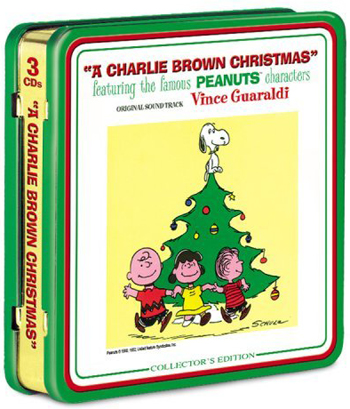
In between, the 2007 holiday season debuted an attractively packaged and priced tin ($18.99) containing
three CDs: the Mark 2 version of Concord's 2006 remixed A Charlie Brown Christmas, including the four
bonus tracks (in a standard jewel case, rather than the original's fancy cardboard case with window); the compilation album 40 Years: A Charlie Brown Christmas; and the 1998 album, Charlie
Brown's Holiday Hits. This was an incredible bargain at less than $20, assuming you didn't already have all
these albums (probably not true of most people reading this article!). Otherwise, you spent a lot of money
for a tin container ... although, in fairness, it is pretty cute.
By the middle of the 21st century's first decade, downloadable digital versions of Guaraldi's album also
had become readily available, typically from sources such as iTunes and Amazon.com. These aren't "different" from
earlier existing recordings, except in a possibly negative sense, since by definition such downloads are
compressed from the original LP- and CD-quality sound, which audio purists will argue is a very bad thing.
Digital versions also don't come with original cover art, and therefore aren't worth discussing at greater
length here.
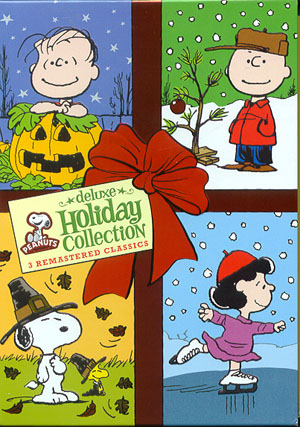
In September 2008, Warner Home Video packaged three of the most popular Peanuts TV specials -- A
Charlie Brown Christmas, It's the Great Pumpkin, Charlie Brown and A Charlie Brown
Thanksgiving -- into a box set issued as the Peanuts Deluxe Holiday Collection. Although these three
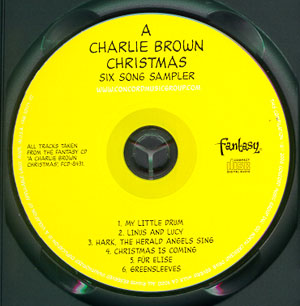
DVDs had been available separately, the deal was sweetened with a new CD included with A Charlie Brown
Christmas: a "six song sampler" of music from the original (1983) Fantasy soundtrack album. The six
songs are, in sequence, "My Little Drum," "Linus and Lucy," "Hark, the Herald Angels Sing," "Christmas Is
Coming," "Fur Elise" and the extended version of "Greensleeves." Additionally -- and this is the interesting
part -- buyers of this set received an iTunes code good for the free download of two more songs: the vocal
version of "Christmas Time Is Here" and, once again, "Hark, the Herald Angels Sing" ... but these two tracks
are taken from Fantasy's 2006 remixed re-issue of the soundtrack! (Forgive a personal comment here, but
that's just plain weird!) For those who may not have wanted to purchase the 2006 CD, this was an easy
way to compare the different studio work on both versions of "Hark, the Herald Angels Sing" ... and it was
easy to notice how much cleaner and "pure" the newer version is.
(Alas, this set is no longer available, and the download codes almost certainly no longer work.)
Starbucks went back to the well during the 2010 holiday season, with an
attractively priced "deluxe edition CD and DVD": two discs, the first of the album
soundtrack, and the second containing the TV special itself. As with the 1997
Starbucks-branded version of the album, this one also did not include the 12th track:
the bonus version of "Greensleeves."
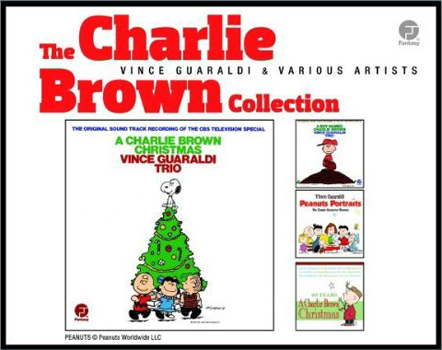
In late 2011, as if to go the 2007 tin one better, Fantasy released a four-CD
"holiday" set dubbed The Charlie Brown Collection. The package art was
dominated by A Charlie Brown Christmas, which was accompanied by two other
discs of Guaraldi's (non-holiday) Peanuts music -- 1964's A Boy Named
Charlie Brown and 2010's Peanuts Portraits -- and David Benoit's 2005
anniversary compilation, 40 Years: A Charlie Brown Christmas. The big
question, of course, concerned which version of Guaraldi's A Charlie Brown
Christmas was included in this set. Answer: the original plain-vanilla 1986 CD
recording, complete with its familiar audio imperfections.
Prices varied from $26 to $34 upon release, which was good but not great;
it appeared as though Fantasy used the two popular discs (Guaraldi's 1960s releases)
to generate some additional sales for the two more recent releases.
(Which vexed me a bit. Full disclosure prompts me to acknowledge my
involvement with Peanuts Portraits; Fantasy commissioned me to write
the extensive liner notes. I'd hate to think the disc wasn't performing!)
Perhaps still wincing from the "controversy" of the 2006 edition, Fantasy issued a newly remastered (but not remixed)
edition of the album in 2012, with digital restoration engineer Joe Tarantino returning to the label's original
CD release, back in the late 1980s. The results are impressive, if perhaps too subtle to be noticed by
casual listeners. Guaraldi's piano -- both more detailed and warmer than on that somewhat brittle-
sounding first CD -- sits better in the mix here. This draws greater attention to the equally
superlative work by the sidemen; in particular, you'll hear marvelous bass riffs that have been all
but buried until now. The disc features the original LP's 11 tracks, along with the bonus version of
"Greensleeves." Somewhat surprisingly, this new release also includes "Great
Pumpkin Waltz" and "Thanksgiving Theme," both already available on Charlie Brown's Holiday Hits ...
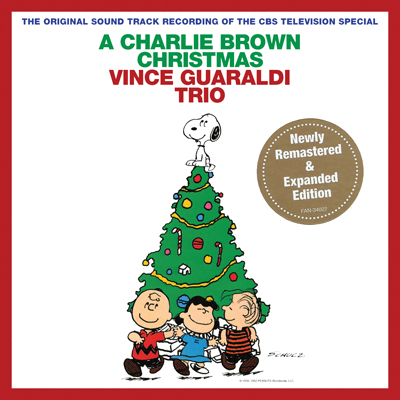
although it is nice to hear them improved, as well, by Tarantino. Happily, you can easily tell this
release from its predecessors, thanks to the bright red border surrounding the cover.
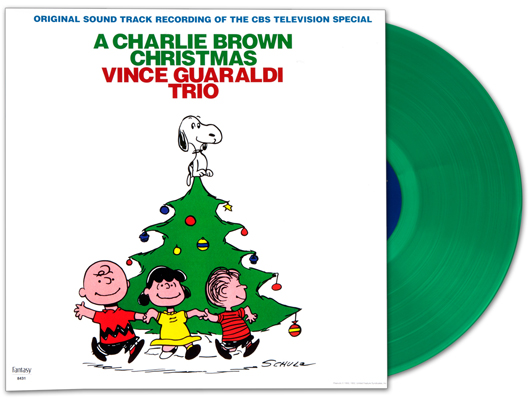
For those who love the sound and look of old-style LPs, Fantasy also issued a new pressing of this album on green vinyl in 2012.
This is an affectionate nod to Fantasy's early days, when owners Max and Soul Weiss -- having named their company after
the popular science-fiction pulp magazine -- would produce records in unusual colors: green, red and blue translucent vinyl.
The initial pressings of Guaraldi's early Fantasy LPs followed this pattern: usually red vinyl for the monaural version,
and blue vinyl for stereo. I don't believe Fantasy ever granted Guaraldi a green LP, back in the day, so Concord deserves
credit both for reviving this tradition, and giving it a holiday vibe.
Be advised, however: LP lacquer cutting from an analog master (LP) and digital remastering (CD) are two different things.
The contents of this new green vinyl LP did not, as a result, reflect the newly remastered CD discussed above. This LP
was pressed from George Horn's 1988 master (which does include the extra version of "Greensleeves").
This 2012 re-master also popped up in another format, thanks to a company named HD Tracks, which offerred lossless,
uncompressed downloads that were superior to the compressed
AAC or MP3 files offered by iTunes and Amazon; indeed, the HD Tracks version of A Charlie Brown Christmas
was even superior (at 192khz/24bits) to CD quality (44khz/16bits). That means this HD Tracks version was on par or
perhaps even better than SACD (2822khz/1bit). Since then, many additional companies have offerred similar high-resolution
downloads ... which, not being physical releases, will not be discussed further.
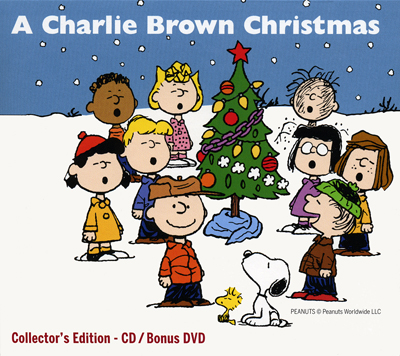
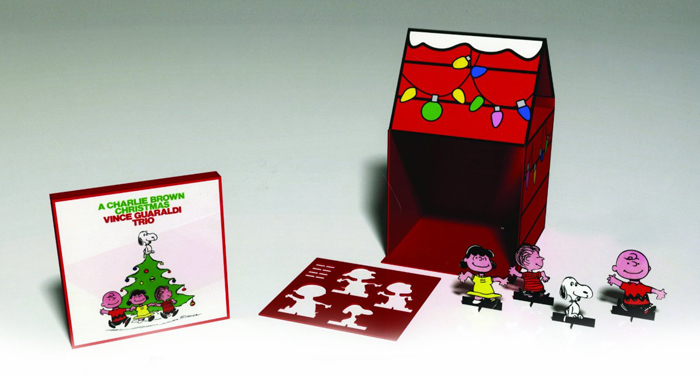
Fantasy played with the packaging for its next re-release of the album, which debuted the following year,
on October 22, 2013. The disc itself was the same as the 2012 remastered edition, but the CD "sleeve" blossomed
into something truly unusual. As you shown in the photo below, the customized sleeve unfolds and converts into
Snoopy's decorated doghouse. The package also came with four character cutouts and stands, so one can set up a tiny holiday
tableau, as shown. (The relative scale of the figures and doghouse is somewhat off, which probably raised a few eyebrows.)
It was an intriguing marketing ploy: the CD equivalent of the opulent debut release of Guaraldi's Jazz Impressions of
a Boy Named Charlie Brown, back in December 1964. Fantasy issued the first run of that LP with a gatefold album
jacket that included a dozen 8-by-10, frame-ready Charles Schulz "posters" of the Peanuts gang. (See the
Guaraldi discography for further details about that album.)
Appearances to the contrary, Fantasy released a second "new" Guaraldi item in late 2013, which doesn't belong on this list.
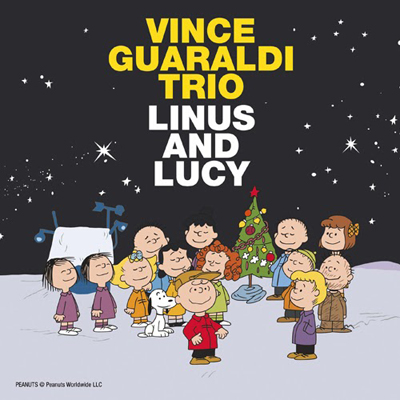
In tandem with the Record Store Day committee's "Back to Black Friday" celebration on November 29, we were treated with the gold
vinyl 45 single pictured at left. But although the cover art featured the heartwarming final scene from A Charlie Brown Christmas,
the disc actually was a re-creation of the 1964 single that Fantasy issued along with the LP Jazz Impressions of A Boy Named
Charlie Brown, which contained "Linus and Lucy" and "Oh, Good Grief." Additional details can be found
here.
Fantasy/Concord let the album rest during 2014, but they roared back -- with a vengeance -- in 2015, to take advantage of the album's
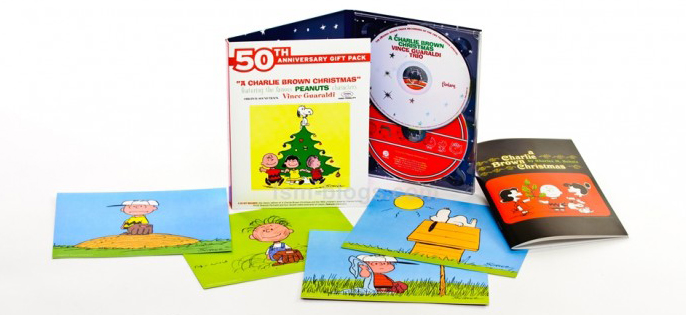
50th anniversary. On the digital front, November 1 marked the debut of the Charlie Brown Christmas 50th Anniversary Gift Pack,
which included the original 11-track Charlie Brown Christmas soundtrack; the 2010 release, Peanuts Portraits;
a reproduction of the children's book version of A Charlie Brown Christmas; and four double-sided postcards featuring
various members of the Peanuts gang. (Sharp-eyed fans recognized the postcard images as smaller versions of the mini-posters
originally packaged with Fantasy Records' first-run LP pressings of Jazz Impressions of A Boy Named Charlie Brown.)
On the negative side, this item was a Walmart exclusive ... but only the first year. (Starting in 2016,
it became available everywhere.)
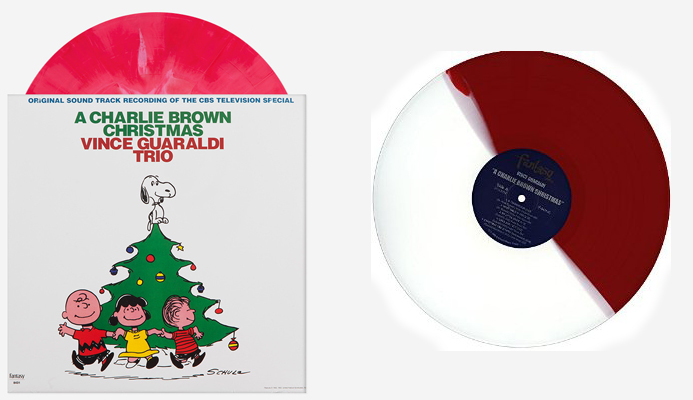
But that wasn't all. Vinyl fans must've torn out their hair, because the same day marked the debut of three colored vinyl,
retailer-exclusive editions of the soundtrack:
1) Red and green vinyl, available only at F.Y.E. stores
2) Red vinyl, available only at Urban Outfitters
3) A "pink ribbon candy" swirl, available only at Newbury Comics (and a successor to their 2014 red/white split LP, both pictured below)
And, of course, the existing green vinyl version remained available to all via Amazon.
This ignited what soon became an annual tsunami of vinyl variants ... but, since these were solely packaging
changes -- meaning, the music contents remained the same -- they're covered in a separate article, which can be found
here.
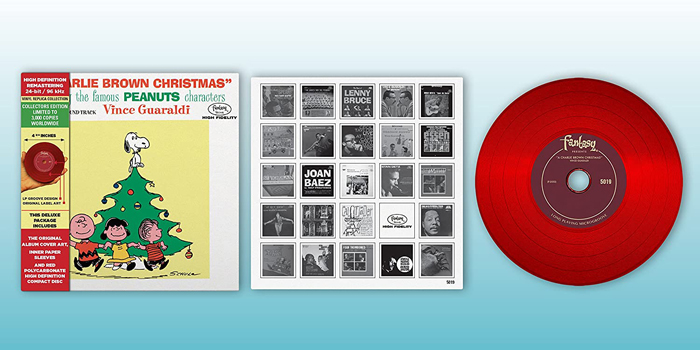
Later that same year -- November 6, to be precise -- the specialty label Culture Factory, which reissues
classic albums in limited edition mini-LP replica sleeves, selected A Charlie Brown Christmas as one of
its four seasonal re-issues (alongside The Beach Boy's Christmas Album, James Brown's Soulful Christmas
and Meco's Christmas in the Stars: The Star Wars Christmas Album). Guaraldi's album -- a "Collector's Edition
limited to 3,000 copies worldwide" -- was available exclusively via FYE, and the CD is noteworthy for being red.
This also was a new remastering, unique to this Culture Factory release.
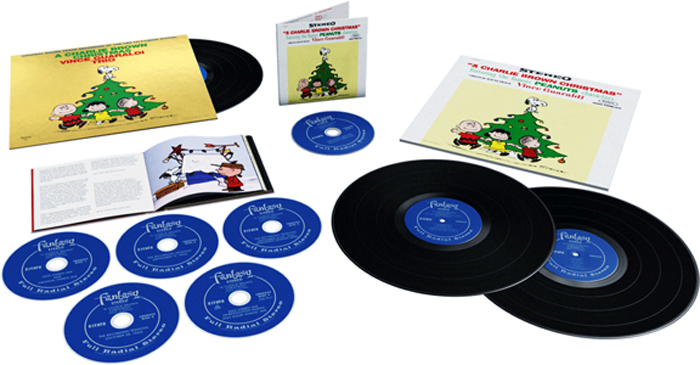
2022 brought us the Holy Grail -- the fabled unicorn, the treasure chest at the end of the rainbow, your
glittering prize of choice -- when on October 14 Craft Recordings released what they (modestly) called the
"Definitive, Super Deluxe Edition of A Charlie Brown Christmas."
The hyperbole for this five-disc set was justified.
While audiophiles likely salivated over Disc 5's Blu-Ray Audio 2022 stereo mix and 2022 Dolby Atmos mix of
the original 1965 album, the set's true buried treasures were found on Discs 2 through 4: five original studio
recording sessions, taking place between September 17 and October 28 that year, during which most of the
album's tracks -- and particularly Guaraldi's original tunes -- were shaped, rehearsed, modified and
occasionally fluffed.
As I discuss, within the 56-page booklet that accompanied this release, some of Guaraldi's new songs --
notably "Christmas Time Is Here" -- began life quite close to the version we know and love today. Others,
such as "Skating" and "Christmas Is Coming," had a difficult birth, as Guaraldi wrestled with different
bridges and ways to conclude them. As just one example, this set features 16 takes (!) of "Christmas Is
Coming," as Guaraldi and his sidemen shaped this rockin' tune into its final format
These sessions include plenty of commentary -- and occasional bursts of frustration -- between Guaraldi
and his sidemen; listeners can hear everything precisely as it all occurred, as if sitting alongside
the recording engineer.
**********
And there you have it ... far more than you ever needed to know about one of our favorite albums,
which has remained in print -- and sold steadily, year after year -- since its debut more than half a century ago.
Indeed, it placed in the Top 10 in the Billboard 200 album list during most of December 2021, competing against mostly
new albums, and peaked at #6 ... a pretty impressive feat, for an album four decades old!
We know why, of course: Guaraldi's touch and musical approach are timeless. His arrangement of "O Tannenbaum,"
for example, has become fixed so firmly in my mind that I judge all other versions by how closely they adopt
Guaraldi's approach ... which I realize is completely daft, but it's beyond my control.